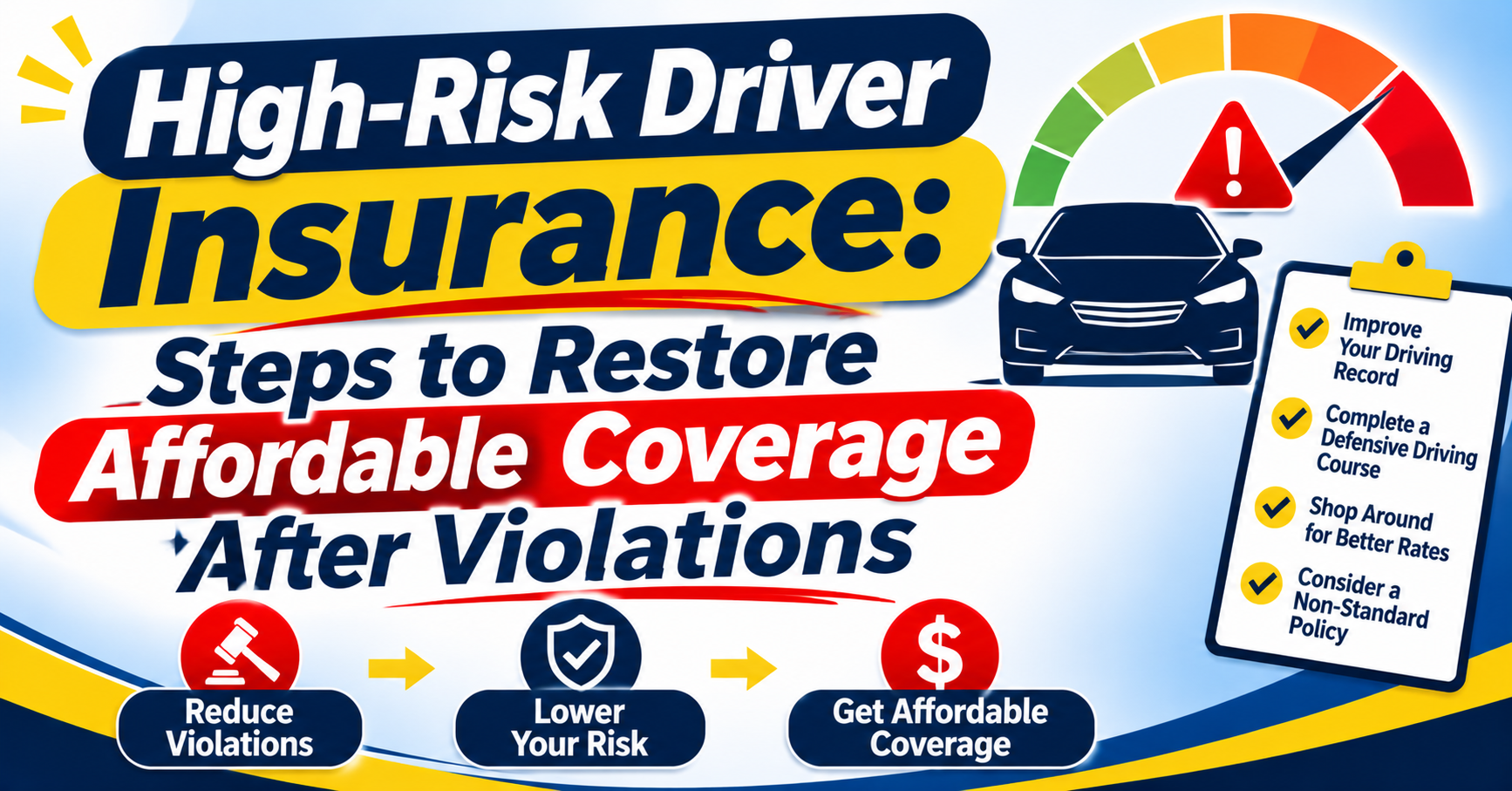
High-Risk Driver Insurance: Steps to Restore Affordable Coverage After Violations – A few traffic violations or an at-fault accident can have consequences that extend well beyond fines and repair bills. Insurance companies may classify you as a high-risk driver, increase your premiums, restrict your coverage options, or decline to renew your policy. Serious offences, such as driving under the influence or driving while disqualified, can make finding affordable insurance even more difficult.
However, being labelled a high-risk driver does not necessarily mean you will face expensive premiums forever. Insurers assess risk using different criteria, and your insurance options may improve as violations become older and you establish a consistent record of responsible driving.
The key is to understand what caused the higher insurance costs, maintain any legally required coverage, and take practical steps to demonstrate that your risk has improved. This guide explains how high-risk driver insurance works and how to work toward more affordable protection.
What Is High-Risk Driver Insurance?
High-risk driver insurance refers to motor insurance offered to drivers whom insurers consider more likely than average to make a claim. It is not always a separate insurance product. In many markets, it describes standard or specialised policies issued under different underwriting conditions and premium rates.
You may be classified as high-risk because of:
- Multiple speeding tickets or other traffic violations.
- At-fault accidents or repeated insurance claims.
- Driving under the influence of alcohol or drugs.
- Driving with a suspended, revoked, or disqualified licence.
- A history of driving without valid insurance.
- Previous policy cancellations for non-payment.
- Serious offences involving dangerous or reckless driving.
Insurers do not all assess these factors in the same way. One company may decline an application while another may offer coverage at a higher price. Your classification can also depend on local insurance regulations, the seriousness of the violation, and how recently it occurred. <a href=”https://www.fsrao.ca/consumers/auto-insurance/understanding-auto-insurance-rates/high-risk-drivers“>Ontario’s Financial Services Regulatory Authority</a> explains that multiple convictions, at-fault accidents, and certain insurance payment problems can contribute to high-risk classification.
How Traffic Violations Affect Insurance Premiums
Insurance premiums reflect an insurer’s assessment of the likelihood and potential cost of future claims. A driving record containing serious or repeated violations can indicate a greater risk of accidents, injuries, and vehicle damage.
Speeding and moving violations: Repeated speeding offences, dangerous driving, and other moving violations can increase premiums. The impact depends on the offence, the insurer’s rating rules, and the applicable lookback period.
At-fault accidents: An accident for which you are responsible may result in a premium increase, loss of a safe-driver discount, or stricter renewal conditions. The effect can depend on the claim amount and the insurer’s rules.
Driving under the influence: DUI or similar convictions can have serious consequences, including licence suspension, higher premiums, restricted insurer options, and special proof-of-insurance requirements in some jurisdictions.
Driving without insurance: A lapse in coverage can make it harder to obtain affordable insurance. Some insurers consider previous coverage history when assessing applications, although the extent to which they can use this factor varies by location.
Licence suspension or disqualification: A suspended licence may prevent you from legally driving until reinstatement requirements are met. Even after reinstatement, the underlying offence may continue to affect insurance eligibility and pricing.
Read: Imported Vehicle Insurance: Coverage Requirements, Restrictions, and Cost Factors
Steps to Restore Affordable High-Risk Driver Coverage
Improving your insurance position takes time, but a structured approach can help.
1. Review Your Driving Record
Start by obtaining an official copy of your driving record from the relevant licensing authority. Check the listed violations, accident information, licence status, and dates.
Errors can occur. A conviction may be recorded incorrectly, an offence may appear after it should have expired under applicable rules, or information may belong to another driver. If you identify an error, follow the official process for correcting or disputing it.
Do not assume that paying a traffic fine automatically removes a violation from your driving record. Different authorities have different rules for recording and retaining offences.
2. Resolve Outstanding Legal and Licensing Requirements
Before seeking cheaper insurance, make sure your licence and vehicle comply with applicable legal requirements.
Depending on the violation, you may need to pay outstanding fines, complete a court requirement, attend a driver improvement programme, or satisfy a licence reinstatement condition.
If your licence has been suspended or revoked, do not drive until the relevant authority confirms that your driving privileges have been restored. Insurance does not give you permission to drive when you are legally disqualified.
3. Compare Quotes From Multiple Insurers
Do not assume your current insurer offers the best available rate. Insurance companies use different underwriting criteria, and some specialise in drivers who have violations or previous claims.
Request quotes from several providers, including insurers that offer non-standard or high-risk policies. Give each company accurate information about your driving history so that the quotes reflect your actual circumstances.
Compare more than the headline premium. Review liability limits, deductibles, exclusions, cancellation terms, payment fees, and available optional benefits.
If a company declines your application, ask whether it can recommend an alternative underwriting programme or whether you may qualify for coverage through a local insurance pool or assigned-risk arrangement.
4. Complete an Approved Defensive Driving Course
A recognised defensive driving course can help demonstrate your commitment to safer driving. Depending on the jurisdiction and insurer, completing an approved programme may qualify you for a discount, satisfy a legal requirement, or support a broader risk-reduction effort.
Before enrolling, ask whether the course is recognised by your licensing authority and whether your insurer accepts it for premium discounts. Not every course produces an insurance saving, and any discount depends on local rules and the provider’s terms.
5. Maintain Continuous Insurance Coverage
Allowing your policy to lapse can make an already difficult insurance situation more expensive. Even a short gap may affect how some insurers assess your application.
If your current policy is becoming unaffordable, seek alternative coverage before cancelling it. Choose a policy that meets the legal minimum and provides appropriate protection for your circumstances.
Pay premiums on time and keep proof of insurance accessible. If monthly payments are difficult, ask about instalment arrangements, payment dates, or alternative policy options.
6. Consider Telematics or Usage-Based Insurance
Some insurers offer telematics policies, sometimes called black-box or pay-how-you-drive insurance. These products use a device, smartphone application, or built-in vehicle technology to assess driving behaviour.
Depending on the programme, the insurer may monitor factors such as speed, braking, mileage, time of travel, and driving patterns. Demonstrating safer driving may help some customers qualify for better renewal terms or other benefits.
However, telematics is not automatically cheaper. Poor driving scores may lead to higher premiums, additional charges, or policy restrictions. Read the privacy terms, data-use provisions, and pricing rules before enrolling. <a href=”https://www.abi.org.uk/policy-and-guidance/insurance/personal-insurance/motor-insurance/pay-as-you-drive-insurance“>The Association of British Insurers</a> explains how telematics policies assess driving performance and how results can affect premiums and renewal benefits.
7. Adjust Your Vehicle and Coverage Choices
The vehicle you insure can influence the price of coverage. High-performance models, expensive vehicles, and cars with costly replacement parts may attract higher premiums.
If your budget is limited, consider a vehicle with strong safety features, lower repair costs, and a lower insurance risk profile.
You can also review optional coverages and deductibles. A higher deductible may reduce the premium, but only choose an amount you could realistically afford after an accident. Do not reduce liability limits below legal requirements or remove essential protection simply to obtain a lower quote.
8. Ask About Discounts and Review Your Policy at Renewal
Ask insurers whether you qualify for discounts based on approved driver training, low annual mileage, vehicle security, multiple policies, or other eligible factors.
Some discounts are unavailable to certain high-risk applicants, and eligibility differs between providers. Request the actual saving rather than assuming a discount makes one quote cheaper overall.
Review your policy at each renewal. If your record has improved, ask the insurer to reassess your risk and check whether a more competitive rate is available.
How Long Does a High-Risk Classification Last?
There is no universal period during which a driver remains high-risk. Insurers use different lookback periods, and local laws may limit how long certain offences can influence premiums.
In some markets, ordinary traffic violations and accidents may affect insurance pricing for approximately three to five years. Serious convictions, including DUI offences, may have longer-lasting consequences. The time an offence remains on an official driving record can also differ from the period an insurer is permitted to consider it.
For example, the Ohio Department of Insurance explains that insurers may use different periods when considering accidents and violations, with some looking back three years and others up to five. <a href=”https://insurance.ohio.gov/consumers/automobile/automobile-insurance-guide“>Ohio’s automobile insurance guide</a> also recommends reviewing coverage options as a driving record improves.
Ask your insurer exactly when an incident will stop affecting your premium. Do not assume that a rate will automatically decrease after a particular number of years.
Special Insurance Requirements After Serious Violations
Some jurisdictions require drivers with specific convictions or licence suspensions to provide additional proof of financial responsibility.
In certain US states, this may involve an SR-22 certificate or a similar filing. An SR-22 is generally a document filed by an insurer with the relevant authority to demonstrate that the driver has the required insurance. It is not itself an insurance policy.
Requirements differ by state. For example, Virginia uses SR-22 and FR-44 filings for specified circumstances, with FR-44 requirements applying to certain serious alcohol-related driving convictions and requiring higher liability limits. <a href=”https://www.dmv.virginia.gov/businesses/insurance/certifications“>Virginia Department of Motor Vehicles</a> provides details of these requirements.
Other countries may use different financial-responsibility procedures, licence reinstatement conditions, or mandatory insurance arrangements. Do not assume that an SR-22 applies outside the relevant US jurisdictions.
Common Mistakes High-Risk Drivers Should Avoid
Hiding previous violations: Inaccurate answers on an insurance application can lead to incorrect quotes, claim disputes, or cancellation where permitted by law.
Choosing only the cheapest policy: A low premium may come with inadequate liability limits, high deductibles, or significant exclusions.
Driving while suspended: Insurance does not override a licence suspension or other legal driving restriction.
Allowing coverage to lapse: A gap in insurance may make future coverage more expensive and expose you to legal and financial consequences.
Failing to compare renewal offers: Your current insurer may not provide the most competitive rate after your driving history improves.
Ignoring policy conditions: Some high-risk policies have specific payment, driver, vehicle-use, or documentation requirements. Failing to meet them can jeopardise coverage.
Frequently Asked Questions
Can I get car insurance after multiple traffic violations?
Yes. Some insurers specialise in high-risk drivers and may accept applicants with multiple violations, although premiums and available coverage may be less favourable. If ordinary insurers decline your application, investigate any local assigned-risk or insurance-pool arrangements.
Will my insurance premium automatically decrease after a violation expires?
Not necessarily. A violation becoming too old to affect your rate under one rule does not guarantee an automatic reduction. Ask your insurer for a review and compare new quotes when the relevant lookback period ends.
Can I switch insurers while classified as high-risk?
In many markets, yes. However, a new insurer will still assess your driving history and may offer a similar or higher premium. Confirm that the new policy is active before cancelling existing coverage.
Does a defensive driving course remove violations from my record?
Usually not. A course may satisfy a legal requirement or qualify you for an insurance discount, but it does not automatically erase a conviction. Check the rules in your jurisdiction.
What if no insurance company will cover me?
Ask a licensed insurance broker or regulator about specialist providers, assigned-risk plans, or other last-resort insurance arrangements available in your area. Availability and eligibility differ by country and region.
Can I get comprehensive coverage as a high-risk driver?
Possibly. Some insurers offer comprehensive policies to high-risk drivers, while others may limit cover to third-party liability or impose additional conditions. The vehicle, driving history, and insurer’s underwriting rules will influence the options available.
Conclusion
High-risk driver insurance can be expensive, but a history of traffic violations does not have to define your insurance costs indefinitely. Reviewing your driving record, resolving outstanding legal requirements, maintaining continuous coverage, completing approved driver training, and comparing specialist insurers can help you rebuild your insurance position.
The most important step is to demonstrate consistent responsible driving while keeping the coverage you need. Review your policy regularly, ask when past violations will stop affecting your premium, and avoid unnecessary coverage gaps. With time and careful comparison, you may be able to move toward more affordable insurance and broader protection.